
St Spyridon born c270 AD in Askia, Cyprus, died in c348 AD
St Spyridon occupies a unique place in Christian history. Unlike many saints who are remembered for one or two extraordinary events, St Spyridon has been associated with a continuous tradition of miracles spanning more than 1,600 years.
His life demonstrates the biblical principle that “God chose what is foolish in the world to shame the wise” (1 Corinthians 1:27). Though a simple shepherd with little formal education, he became one of the Church’s most revered bishops and wonderworkers.
Miracles During His Lifetime
1. Healing the Sick St Spyridon was renowned for healing many who came to him suffering from illness. Accounts describe him praying over those afflicted with: paralysis, blindness, severe fevers, and various incurable diseases. Unlike physicians of his time, he charged nothing and always pointed people to Christ as the true healer. His ministry echoes the words of Jesus: “Heal the sick… Freely you have received; freely give.” (Matthew 10:8)
2. Raising the Dead One of the most striking traditions concerns the resurrection of a dead child. According to early accounts, a grieving mother brought her deceased child to St Spyridon. Moved with compassion, he knelt in prayer and asked Christ to restore the child’s life. The child revived, and the astonished mother, overwhelmed with emotion, herself collapsed and died. St Spyridon then prayed again, and she too was restored to life. This represented God’s power over death due to the prayers of the Saint.
3. Miracle of the Snake Turned into Gold This is one of the best-known stories from his life. A poor farmer needed money to survive a difficult season and sought help from St Spyridon. The Saint had no wealth to give him. He picked up a snake from the ground and, through prayer, it was transformed into a bar of gold. The farmer used the gold as security for a loan, saved his farm, and later returned to repay the loan. St Spyridon then took the gold back into his hands, prayed, and it returned to being a living snake, which slithered away.
4. Bringing Rain During a Drought During a severe drought that threatened famine, St Spyridon prayed earnestly for rain. Soon afterward, heavy rain fell upon the land, saving the crops and preventing widespread hunger. Later, when excessive rainfall threatened destruction, he prayed again, and the rain ceased. This recalls the ministry of the prophet Elijah (1 Kings 17–18), showing that a prayer of a righteous man works powerfully before God, Who remains sovereign over creation.
5. Ending Famine During another famine, a wealthy grain merchant refused to sell food except at inflated prices. St Spyridon rebuked his greed and warned that trust should be placed in God rather than wealth. According to tradition, the merchant’s grain stores were opened by a violent storm, allowing grain to spill into the streets. The poor gathered what they needed, while the merchant learned humility through the experience. The account echoes biblical warnings against exploiting the poor (Amos 8:4–7).
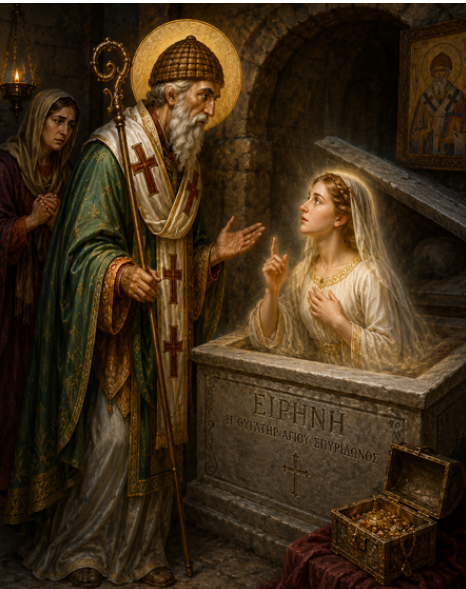
6. The Miracle of St Spyridon and His Daughter Irene St Spyridon had one daughter named Irene, who was known for her holiness and purity of life. A wealthy woman entrusted Irene with a valuable piece of jewellery (usually described as a gold ornament or valuable jewel) for safekeeping. Before Irene could return it, she died.
Some time later, the owner returned asking for her precious jewel. St Spyridon had no idea where his daughter had hidden it. Filled with compassion for the distressed woman, he went to Irene’s tomb and prayed. According to tradition, he called to his daughter: “My daughter Irene, where have you placed the jewel entrusted to you?”
Irene answered him from the grave, telling him exactly where the jewel had been hidden. St Spyridon went to the place she had described, recovered the jewel, and returned it to its rightful owner. Having completed this act of justice, Irene rested once again in peace.
7. Delivering the Innocent from Execution A friend of St Spyridon had been falsely accused of a crime and sentenced to death. The Saint hurried to intervene but encountered a river swollen by floodwaters. Unable to cross safely, he prayed and commanded the waters in the name of Christ. The river is said to have parted or subsided sufficiently for him to cross. He reached the court in time, exposed the false accusation, and secured the innocent man’s release. This miracle resembles biblical accounts such as the crossing of the Jordan (Josh 3).
8. The Emperor’s Healing Constantius II suffered from a serious illness after no physician could help him. He dreamed that only St Spyridon could heal him. The Saint travelled to the imperial court, prayed over the emperor, and he recovered. The emperor rewarded him generously, but St Spyridon distributed much of the wealth among the poor. This illustrates his lifelong detachment from riches.
9. The Lamp That Burned Without Oil Tradition records that while serving the Divine Liturgy, the church’s lamp ran out of oil. St Spyridon prayed, and the lamp continued burning. Such accounts emphasise God’s providence and recall biblical miracles such as the widow’s oil (2 Kings 4).
10. The Council of Nicaea and the Brick At the First Council of Nicaea, St Spyridon defended the Church’s faith in the Trinity. Holding a brick, he declared: ‘In the name of the Father, and of the Son, and of the Holy Spirit.’ According to tradition: fire rose upward, water flowed downward, clay remained in his hand. This dramatic sign became one of the best-known symbols associated with St Spyridon. It is understood as a traditional illustration of the Trinity rather than a doctrinal proof.
Miracles After His Death
St Spyridon’s reputation as a wonderworker grew even more after his death.
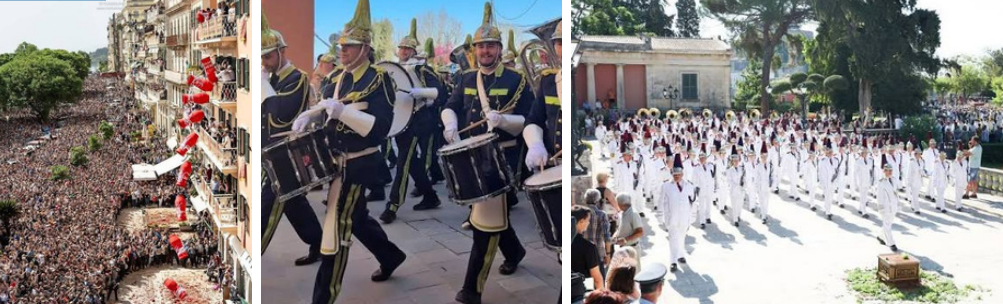
The Protection of Corfu His relics were transferred to Corfu during the fifteenth century. The people of Corfu credit his intercession with delivering the island on several occasions. Traditionally, these include: protection during Ottoman sieges, deliverance from outbreaks of plague, preservation during periods of famine, and aid during other crises. These events are commemorated by annual processions through the streets of Corfu.
The Plague Miracle (1629 and 1673) One of the most famous traditions recounts that during devastating outbreaks of plague, many witnesses reported seeing Saint Spyridon walking through the city carrying a cross or torch. Soon afterward, the epidemic subsided. Out of gratitude, the people established annual commemorative processions that continue today.
The Ottoman Siege of August 1716 Perhaps the most celebrated miracle occurred during the Ottoman siege of Corfu in 1716. According to tradition, defenders and even some attackers reported seeing a venerable bishop clothed in brilliant vestments walking upon the city walls while a violent storm struck the invading fleet. The Ottoman forces unexpectedly abandoned the siege. The people attributed their deliverance to St Spyridon’s intercession and have celebrated this event ever since.
The “Walking Saint” Perhaps the most unusual tradition concerns his incorrupt relics. His body is preserved in Corfu and clothed in embroidered vestments and slippers. Caretakers have long reported that: his slippers become worn, they periodically need replacing, and the old slippers are distributed to pilgrims as devotional relics. Tradition holds that St Spyridon continues to “walk” throughout the world, helping those who seek his prayers. While this belief forms part of Orthodox devotional tradition, the worn slippers themselves are not presented as proof of miraculous journeys but as a cherished sign of the Saint’s ongoing spiritual care.
Processions in Corfu today on 11 August, when St Spyridon saved the people from the Ottoman Siege in 1716
The Spiritual Pattern of His Miracles
When all of St Spyridon’s miracles are considered together, a consistent pattern emerges. His miracles were never performed to draw attention to himself. They reflected the compassionate ministry of Christ by bringing healing to the sick, provision to the poor, justice to the innocent, protection to communities, and encouragement to those whose faith was being tested. In many ways, his life illustrates Jesus’ promise: “Whoever believes in me will also do the works that I do; and greater works than these will he do, because I am going to the Father.” (John 14:12)
For this reason, both Eastern Orthodox and many Eastern Catholic Christians continue to invoke St Spyridon as a powerful intercessor, especially in matters of healing, financial hardship, family needs, travel, and protection. His enduring witness reminds believers that holiness is found not in worldly learning or status but in humble faith, obedience to God, and love for one’s neighbour.
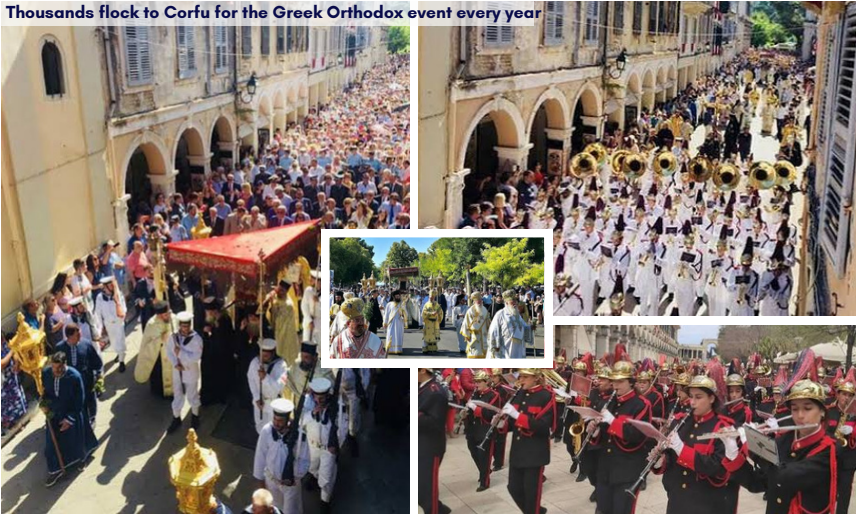
Thousands flock to Corfu for the Greek Orthodox event every year
Prayer to St Spiridon the Wonderworker for Difficult and Impossible Cases
In the Name of the Father, and of the Son, and of the Holy Spirit. Amen.
O holy and glorious Saint Spiridon, faithful servant of Christ, humble shepherd, holy bishop, and great Wonderworker of Corfu, we come before you with confidence, knowing that throughout your earthly life you placed all your trust in God, and that through your prayers countless miracles were wrought for the glory of Christ.
You comforted the poor, healed the sick, defended the innocent, fed the hungry, brought rain in times of drought, protected sailors in danger, and preserved the faithful in times of plague, war, and despair. Even after your holy repose, you continue to intercede for all who call upon you with faith. Today I place before you this difficult situation: (Mention your intention) Beloved St Spiridon, I ask you to carry my prayer before the throne of our Lord Jesus Christ. Obtain for me, if it is according to God’s holy will, the grace I so earnestly seek. When my faith grows weak, strengthen me. When fear overwhelms me, encourage me. When hope seems lost, remind me that nothing is impossible for God. As you once helped those who had nowhere else to turn, come now to my assistance. Pray that every obstacle standing in the way of God’s will may be removed, that every door which God desires to open may be opened, and every door that would lead me away from His holy will may remain closed. Through your powerful intercession, may the Lord grant healing where there is sickness, peace where there is anxiety, reconciliation where there is division, provision where there is need, and hope where there is despair. Above all, obtain for me the grace never to lose confidence in the mercy of Jesus Christ, who alone is our Saviour and Redeemer. May my life always give glory to the Father, and to the Son, and to the Holy Spirit, now and forever. St Spiridon the Wonderworker, pray for us. Amen.
Go to the Magazine July 2026 by clicking on the image below:-