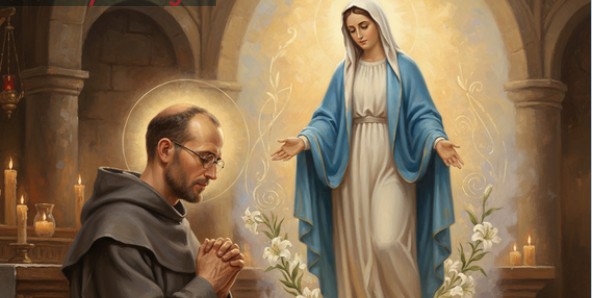
ST MAXIMILIAN KOLBE, PRIEST & MARTYR Feast day: 14 August
St Maximilian Kolbe, a Polish Conventual Franciscan friar, was born on 8 January, 1894. He was very active in promoting the Immaculate Virgin Mary (particularly Our Lady of Lourdes; Lourdes water healed his thumb when he was a young friar) and he is known as the Apostle of Consecration to Mary. His life was influenced by a vision he had of the Virgin Mary when he was 12. Kolbe says: “That night I asked the Mother of God what was to become of me. She came holding two crowns, one white, the other red. She asked if I was willing to accept either of these crowns. The white one meant that I should persevere in purity, and the red that I should become a martyr. I said that I would accept them both.” One year later, Kolbe and his elder brother, Francis, joined the Conventual Franciscans. In 1911, he professed his first vows. At 21, Kolbe earned a doctorate in philosophy from the Pontifical Gregorian University; by 28, a doctorate in theology. Kolbe created the Militia Immaculata (Army of the Immaculate One) after witnessing demonstrations against Pope Pius X and Benedict XV. His goal was to work for the conversion of sinners and enemies of the Church, specifically, the Freemasons, through the intercession of Mary. In 1918, he was ordained a priest. He founded a monthly magazine, “Rycerz Niepokalanej” (Knight of the Immaculate); operated a publishing press and founded a new Conventual Franciscan monastery at Niepokalanow (about 42km west of Warsaw); as well as monasteries in Japan and India. In 1936, Kolbe’s poor health forced him to return to Poland, and once the WWII invasion by Germany began, he became one of the only brothers to remain in the monastery. He opened a hospital to aid those in need. When his town was captured, he was sent to prison but released three months later. He refused to sign a document that would recognise him as a German citizen with his German ancestry, and continued to work, providing shelter for refugees – including 2,000 Jews. Kolbe’s publishing house issued many anti-Nazi publications. On 17 February, 1941, the monastery was shut down; Kolbe was arrested by the Gestapo and taken to Pawiak prison. Three months later, he transferred to Auschwitz. Never abandoning his priesthood, Kolbe was subjected to severe violence and harassment. In the second month in Auschwitz, men were chosen to face death by starvation to deter thoughts of escaping. Kolbe volunteered to take the place of a chosen (family) man. During his last days Kolbe made his cell into a chapel and led prisoners in prayer to Our Lady. He was the last of the group to stay alive, after two weeks of dehydration and starvation. The guards gave him a lethal injection of carbolic acid. He raised his left arm and calmly awaited death. St Maximilian Kolbe died as a Martyr of Charity on 14 August 1941; his remains were cremated on 15 August, the feast of the Assumption.
Go to the Magazine July 2026 by clicking on the image below:-