OUR ‘PERPETUAL’ MIRACULOUS 54-DAY ROSARY NOVENA
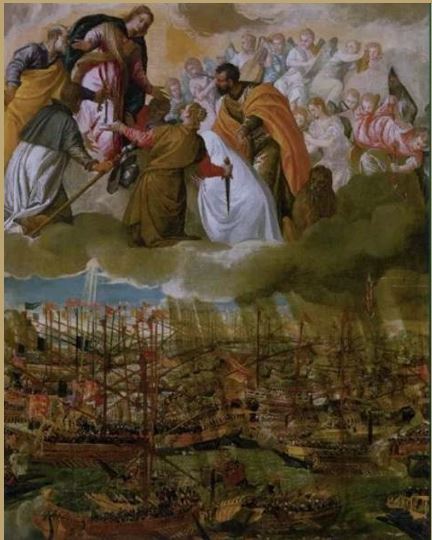
Our world today would look very different if not for Our Lady of Victory’s miracle at Lepanto over 450 years ago.
On 2 August, 1571, at Famagusta — the besieged and last remaining Christian outpost on the island of Cyprus Marcantonio Bragadin and Astorre Baglioni, two Venetian commanders, surrendered to the Ottoman Turk commander, Lala Mustafa Pasha. The battle at Famagusta had been a bloodbath, with a Christian force of fewer than 10,000 utterly overwhelmed by a Muslim force of more than 100,000. The Christians fought to the death, suffering upward of 90 percent casualties.
Bragadin and Baglioni had been assured honourable terms of surrender. When they went to Mustafa’s tent, they instead were immediately arrested. Baglioni was beheaded. But Bragadin, the governor general of Famagusta, would be turned into an example. Mustafa himself pulled out a blade and cut off Bragadin’s right ear. He then ordered his lieutenants to slice off Bragadin’s left ear and nose. For nearly two weeks he was put in a cage and exposed to the intense sun without food and little water. He was offered freedom on the fourth day — if he converted to Islam. He refused.
On 17 August he was hung from the mast of his own ship and scourged with over one hundred lashes, then he was forced to carry a basket full of stones and sand on his shoulders through the streets of Famagusta until he collapsed. He was then brought back to the main square of the city and chained to a column, upon which a Genoese renegade begun to flay him alive from the shoulders down. The Venetian commander endured the martyrdom with heroic courage, continuing to recite the Miserere (Psalm 51) and to invoke the name of Christ until, after his arms and torso had been skinned, he cried out: “In manus tuas Domine commendo spirituum meum“ (“Into your hands, O Lord, I commend my spirit”) and expired. It was three in the afternoon on 17 August, 1571. Bragadin’s body was then quartered, and with his flayed skin stuffed with straw and cotton and clothed with the garments and insignia of command, was carried in a macabre procession through the streets of Famagusta and then hung from the mast of a galley, which carried him to Constantinople as a trophy, together with the heads of the other Christian leaders.
When the news of the massacre reached Pope Pius V and fellow Christians several weeks later, there was outrage. There was a commitment to do something about it. There was also prayer. The Pope increased his prayers and his fasting, dedicating many hours per day to prayer and three days per week to fasting.
Pius V had been pope for only one year, coming in just a year after the Siege at Malta, where the heroic Knights of Malta had defended not only their island but also much of the Mediterranean and Europe. Had the Knights failed at Malta in 1565, all of Europe could have faced a series of episodes like Famagusta. Pius V became pope the next year, in 1566, the start of a short but pivotal papacy.
Pius V knew how precarious this moment was. Various pontiffs had ordered Crusades to defend Christians from Muslim attacks dating back 500 years to the late 11th century. Virtually all of them ended in failure. The Ottomans had revelled in a long run of conquests under Suleiman the Magnificent, who since the 1520s had wiped out Christians and captured their territory, killing and enslaving many.
54-Day Rosary Novena group page on our website: https://jesus4usall.com/devotional/54-day-rosary-novena/
Go to the Magazine December 2025 by clicking on the image below:-